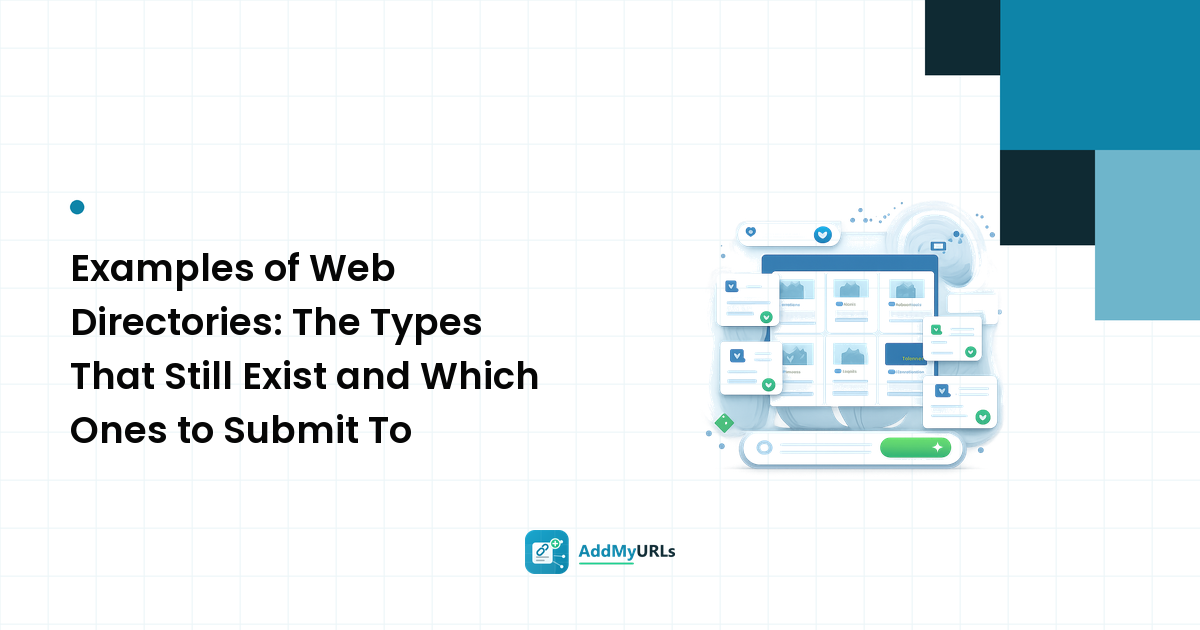
A web directory is a website that catalogues other websites by category rather than by search query. Examples still operating today fall into five types: general directories (Curlie), local and map directories (Google Business Profile, Yelp), niche industry directories (Crunchbase, AlternativeTo), review directories (G2, Capterra, Clutch), and community-curated lists (GitHub "awesome" lists, association member rosters).
That five-way split matters more than any list of names, because the type of directory tells you what you'll actually get out of it. A local directory earns you map visibility and citation consistency. A review directory earns you buyer traffic and a profile you have to maintain. A general directory earns you one modest link and a category page. Sorting your options by type first is how you avoid the classic beginner mistake — spending a weekend submitting to forty interchangeable general directories and wondering why nothing happened.
Below is what each type looks like in the wild, what it's realistically worth, and how to find the ones in your own corner of the web.
What counts as a web directory (and what doesn't)
A directory has three defining traits: it organises sites into browsable categories, each listing is a page about a site (name, URL, description, sometimes contact details), and something or someone decides what gets in.
That last trait is the whole game. Search engines have devalued "directories" whose only product is the link itself, and their link-spam guidance names low-quality directory links explicitly. A directory that reviews submissions, prunes dead links, and has humans browsing it is just a useful website that links to you. One that auto-approves anything is a link farm wearing a directory's clothes. The full quality test and the honest value math is worth reading before you submit anywhere.
Things people call directories that aren't: search engines (query-driven, not curated), social profiles, and "submit your link" pages with no category structure or review.
What are the main types of web directories, with examples?
| Type | Real examples | What it's actually good for | Getting in |
|---|---|---|---|
| General / all-topic | Curlie (the volunteer continuation of the old Open Directory Project), Best of the Web, chamber-of-commerce site listings | One legitimate backlink, an extra crawl path, a category page for a new domain | Manual review; can be slow, sometimes queued for months |
| Local & map | Google Business Profile, Bing Places, Apple Business Connect, Yelp, Yellow Pages, Foursquare | Map and "near me" visibility, name-address-phone consistency, real local referral traffic | Verification (postcard, phone, or email), free |
| Niche / industry | Crunchbase (companies and funding), AlternativeTo (software), Justia and Avvo (legal), Healthgrades (medical), TripAdvisor (hospitality) | The highest-intent referral traffic you'll get from any directory, plus topical relevance | Varies — some open submission, some editorially gated |
| Review / marketplace | G2, Capterra, Clutch, Trustpilot | Buyer-stage traffic, comparison visibility, social proof you don't control | Free profiles common; upsells to paid placement |
| Community-curated | GitHub "awesome" lists, trade association member rosters, university and library resource pages, "built with X" showcases | Genuine topical authority and an engaged niche audience | Pull request, membership, or an email to a maintainer |
Two honest notes on that table. First, the historic giants are gone: Yahoo's directory closed in 2014 and DMOZ / the Open Directory Project shut down in 2017, which is where "directories are dead" comes from. Curlie exists because former DMOZ editors kept the project going. Second, several of the biggest names — Yelp, G2, Google Business Profile — are directories that most site owners never think of as directories. They're where the actual traffic is.
Which type of directory should you submit to first?
Work in this order, because it sorts by effort-to-value rather than by convenience:
- If you serve a geographic area, do local first. Google Business Profile, Bing Places, Apple Business Connect, then the two or three local directories people in your town genuinely use. Nothing else in this article competes with map visibility for a local business — the local listings and citations walkthrough covers the name-address-phone consistency rules that make or break it.
- Then niche directories in your industry. One relevant listing where your buyers already browse beats twenty general ones. This is where referral traffic actually converts.
- Then review directories, but only if you'll maintain them. A G2 or Trustpilot profile is a commitment: unanswered reviews are worse than no profile.
- Then a small number of moderated general directories. Useful for a brand-new domain that has almost no links yet. Diminishing returns set in fast.
- Then curated community lists, opportunistically. Hardest to get into, best when you do. Only pitch if you genuinely belong on the list.
- Stop. There is no step seven. Past roughly a dozen quality listings you're spending hours for signals that round to nothing.
How do you find real web directories in your niche?
Names in an article go stale; a repeatable method doesn't. Four ways to build your own shortlist:
- Search the pattern. Query
"your industry" + directory,"your city" + business directory, orbest "your category" tools list. Skim results for pages with real category structure. - Look at where competitors are listed. Search a competitor's exact brand name in quotes. The directory pages that mention them are directories that accept sites like yours.
- Ask your trade body. Associations, chambers of commerce, licensing boards, and franchise networks maintain member directories that outsiders can't buy into — which is exactly why they're worth something.
- Follow your own referrers. Once listings are live, your analytics referral report will show which directories send humans. Do more of those, drop the silent ones.
For each candidate, run the same five checks before spending time: is it relevant to your topic or area, is there evidence of moderation (editorial guidelines, rejection notices, an about page with real people), are its category pages themselves indexed in Google, are the outbound links live rather than a graveyard of 404s, and is the cost — in money or hours — proportionate to one modest link?
What do you actually write in a directory listing?
Prepare one reusable set of fields and stop rewriting from scratch: exact business name, canonical URL (the version your site actually resolves to, with or without www), a one-line description of roughly 15 words, a longer 40–60 word description in plain sentences, the most accurate category available, and consistent contact details.
Write the description for a human browsing the category, not for a keyword. Keyword-stuffed listings are the single most common rejection reason in moderated directories, and the ones that slip through look like spam to the person who might have clicked. Say what you do, who for, and where.
FAQ
Are web directories still used today? Yes, though rarely in the general all-topic form. The directories with real audiences are local (Google Business Profile, Yelp), review-based (G2, Capterra), and niche industry rosters. General directories persist mainly as a modest link and discovery path for new sites.
What was the biggest example of a web directory? Yahoo's directory and DMOZ (the Open Directory Project) were the two defining examples. Yahoo closed its directory in 2014; DMOZ shut down in 2017, with volunteer editors continuing the catalogue as Curlie.
Is Google a web directory? No. Google is a search engine — it crawls and ranks pages in response to queries. Google Business Profile, however, functions as a local directory: category-organised listings that appear in map results.
How many directories should I submit my site to? Fewer than most guides suggest. A handful of relevant, moderated listings — local plus niche — covers the realistic benefit. Volume submission to hundreds of directories is the pattern search engines devalued, and it can attract scrutiny rather than traffic.
Do directory listings get my site indexed? They can help a page get discovered, because crawlers follow links from pages they already visit. But submitted is not the same as indexed, and indexed is not the same as ranked. Sitemaps and direct submission are the more reliable discovery routes, covered in the site submission checklist.
Pick your types, then get listed
Directories aren't a strategy on their own — they're a discovery and citation layer that's cheap to do properly and expensive to do badly. Choose by type, verify moderation, write one honest description you can reuse everywhere, and keep the total effort proportionate to what a listing can realistically deliver.
When you're ready to start that shortlist, add your site and get a backlink — a moderated listing, a real public page, and a report of what your submission actually produced. (Featured spots in the directory are paid placements and are labelled as such.)